

























What to Look for When Buying a League of Legends Account: Skins, Rank, Level and Server Guide
Written by Rutaku Team 9-11 min read 218 views
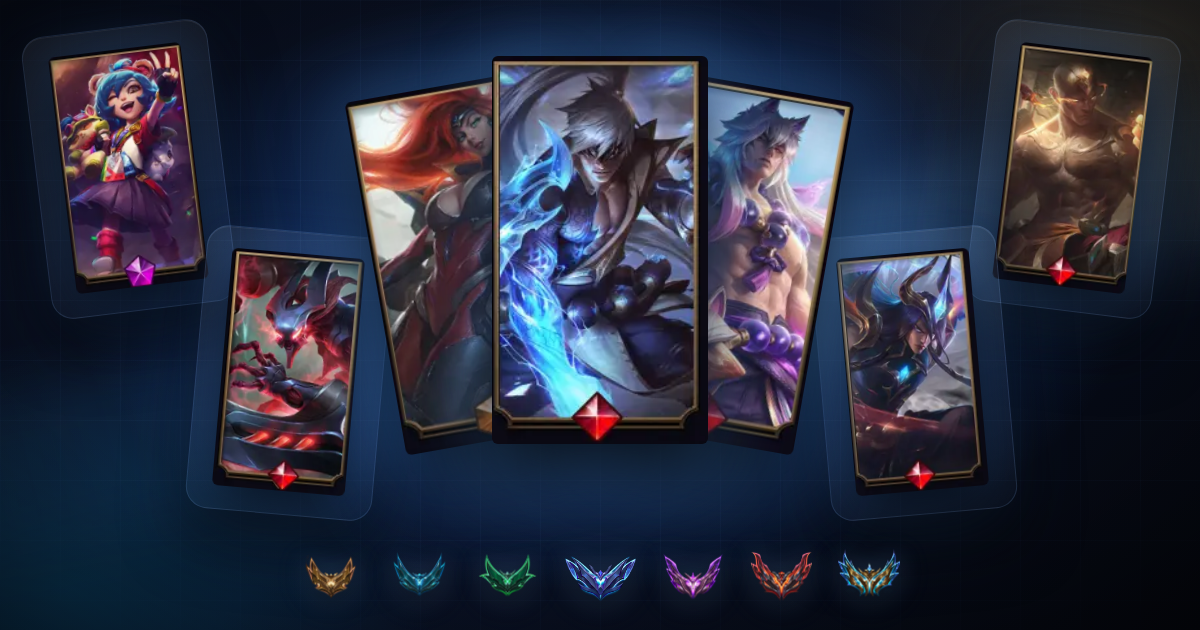
How to read a League of Legends account listing before you buy: NFA and full access, level and champion count, rare skins, rank and MMR, and the differences between the TR, EUW, EUNE and NA servers.
Open any list of League of Legends accounts and the titles read like a code: "UNRANKED - 34 LVL - 2 SKIN" on one line, "SILVER IV - 448 LVL - 321 SKIN" on the next. Every part of that code moves the price, and not always the way you would expect: a higher level does not make an account stronger, a higher rank is not automatically the better buy, and 300 skins can be worth less to you than 30.
This guide explains what each detail means, so you can read a listing properly before you buy a LoL account: access type, level and champion count, skins, rank and MMR, and server. The game details come from Riot's published pages and the League of Legends Wiki, and are current as of November 2026.
Why players choose to buy a LoL account
A new League account starts at level 1 with almost nothing unlocked. In most cases, what a buyer pays for is time. The usual reasons:
- Getting into ranked sooner. Ranked queues open at level 30, and the account also has to own at least 20 champions and have 10 normal Summoner's Rift games behind it. On a second account, that road is mostly waiting.
- A wider champion pool. League has more than 170 champions. Blue Essence, the currency that unlocks them, comes mainly from Battle Pass progression, so a full roster takes a long time to build.
- Skins that can no longer be earned. Some skins belonged to a past season or event and are not coming back. The only way to play with them is an account that already owns them.
- A second account. Players use a smurf to learn a new role, or to queue with friends who play at a different level.
- A different server. Every account belongs to one server. If your friends are on EUW and your account is on TR, you need an account that is already there.
Which reason is yours decides what you should pay for. If all you need is a ranked-ready account, a large skin collection is money spent on something you never asked for.
Differences between NFA and FA accounts
Before level, rank or skins, look at the access type, because it defines what you actually receive.
FA (full access) means the whole account changes hands: you get the login details together with access to the account's email, so you can change both the password and the email to your own.
NFA (non-full access) means you receive the login details for playing, and nothing more. The account's email is not part of the purchase, so you cannot take full ownership of the account. That is why NFA accounts cost so much less.
| NFA (non-full access) | FA (full access) | |
|---|---|---|
| What you receive | Login details for playing | Login details plus access to the account's email |
| Email and ownership | Email not included; the account never becomes fully yours | You replace the email and password with your own |
| Typical use | A low-cost level 30 smurf or a spare account for another server | A main account, or a skin collection you plan to keep |
| Price on Rutaku (20 November 2026) | $0.15 to $45, median about $4 | $0.49 to $349.99, median about $15 |
Neither type is right for everyone. For a few hundred games on a spare account, an NFA account does the job for a few dollars. If you are paying for rare skins, or for an account you will keep for years, full access matches the plan. Rutaku keeps the two on separate pages: full access LoL accounts and LoL NFA accounts.
Why account level and champion count matter
Level. Level 30 is the line that counts, because that is where ranked opens. Past it, level has no effect on gameplay: Riot states that there is no limit to how high an account can level, and a level 400 account hits no harder than a level 31 one. What a high level does tell you is how much the account has been played. "34 LVL" describes an account that has just reached ranked and is close to a blank page. "448 LVL" describes years of matches, which is why accounts like that tend to arrive with skins in the hundreds.
Champion count. This is the number buyers underestimate most. Twenty owned champions is the minimum for ranked, but ranked games use a draft with ten bans, and another player can lock in your pick before your turn comes. With a thin pool you will sooner or later be pushed onto a champion you do not play.
Building a pool yourself is slow. Blue Essence arrives mostly through the Battle Pass, and RP, the paid currency, can only be bought or received as a gift. Rutaku's NFA page groups offers by champion count ("60+ CHAMPIONS", "100+ CHAMPIONS" and higher), and full access listings show the account's champions and Blue Essence next to its rank and skins. One practical rule: an account with 90 champions that includes your mains is worth more to you than one with 140 that does not.
How skins and rare skins affect account value
Skins usually make up the largest share of an account's price, for a simple reason: they stay on the account that unlocked them. Gifting in League means buying something new from the store for a friend on the same server; Riot's gifting rules do not let you give away content you already own.
How much a skin adds depends on how it was obtained. Riot's own Skins 101 overview sorts them roughly like this:
- Store skins. Most skins are sold for RP in tiers such as Epic (1,350 RP), Legendary (1,820 RP) and Ultimate (3,250 RP).
- Prestige and Mythic skins. Typically not sold for RP. Prestige skins come from the paid Battle Pass or from the Mythic Shop, where they cost Mythic Essence, a rare currency.
- Exalted skins. A top tier obtained only through the Sanctum with Ancient Sparks.
- Victorious skins. The ranked reward: since 2025, 15 ranked wins in a season earn that season's Victorious skin. They are not planned to return.
- Legacy skins. Not normally in the store; they come back now and then through events, Your Shop offers or loot.
- Limited skins. Tied to one specific moment and no longer obtainable.
Rarity sits in the last groups. A skin anyone can buy tomorrow for 1,350 RP adds little to an account; a Victorious, limited or Prestige skin cannot simply be added later. So the skin count in a title, "321 SKIN" for example, is a starting point and not a verdict. Two questions tell you more: how many of those skins are hard or impossible to get now, and how many are for champions you play?
One honest note: a single skin that is still in the store does not require a new account, because it can be gifted to the one you already have. Our LoL RP gifting guide explains how, and Rutaku's LoL items page covers RP gifting, Hextech Chests and Keys and the Battle Pass for many regions. An account makes sense when the skins you want are no longer sold, or when you want a large collection in a single step.
Rank and the MMR system
League's ranked ladder has ten tiers: Iron, Bronze, Silver, Gold, Platinum, Emerald, Diamond, Master, Grandmaster and Challenger. Iron to Diamond are each split into four divisions, from IV up to I, and 100 League Points (LP) move you up one division. Master, Grandmaster and Challenger have no divisions; their players share a single ladder ordered by LP. Riot's ranked tiers article has the full structure.
Behind the visible rank runs a hidden number, the matchmaking rating (MMR). MMR decides who you are matched against and how much LP a game is worth. When an account's MMR is above its rank, a win gives more LP than a loss takes away and the account climbs quickly; when it is below, the opposite happens.
For someone reading a listing, three things follow:
- A rank is a snapshot. A ranked year has three seasons, starting in January, April and August. The climb carries over between seasons, but when a new year begins the rank resets: every account plays five placement games per queue and usually starts around a tier below where it finished. A rank bought in November goes through that reset in January.
- "Unranked" is not a flaw. An unranked level 30 account is one where you play the placements and set the rank yourself. Labels such as "LAST SEASON GOLD" tell you where the account finished before, which the next placement takes into account.
- Choose a rank close to your own level. Matchmaking follows MMR, so an account ranked far above your level puts you in games at that level, and the rank settles back towards where you really play. A rank near your real level holds, and it keeps you within duo range of your friends, because Solo/Duo limits how far apart two partners' ranks can be.
One 2026 change matters at the very top: when the year's second season began, Riot reset every Master, Grandmaster and Challenger player on NA, EUW, EUNE, BR, LAN and TR to Master 0 LP, so apex ranks on those servers have all been earned since then.
If what you want is a higher rank on the account you already own, read our LoL elo boost guide.
Differences between the TR, EUW, EUNE and NA servers
Every League account is tied to one server. You are matched only with players on that server, and gifts can only be sent between players on the same one. These are the four servers readers ask about most:
| Server | Hosted in | Client languages | Who plays there |
|---|---|---|---|
| TR (Türkiye) | Istanbul | Turkish | Players in Türkiye |
| EUW (Europe West) | Amsterdam | English, German, Spanish, French, Italian | Western Europe |
| EUNE (Europe Nordic & East) | Frankfurt | English, Polish, Greek, Romanian, Hungarian, Czech | Northern and Eastern Europe |
| NA (North America) | Chicago | English | The United States and Canada |
In practice the choice comes down to two things:
- Ping. The closer you are to where a server is hosted, the lower your latency tends to be. An NA account played from Europe sends every click across the Atlantic.
- Friends and language. You can only queue with people on your own server, so the server your friends play on usually settles the question. TR is a Turkish-speaking server; EUW and EUNE each bring many countries and languages together.
Riot runs more servers than these four. The newest is the Middle East server, hosted in Bahrain with an Arabic client, which opened in June 2024.
Can a server be changed later? Riot sells a transfer for 2,600 RP, described on its server transfer page. Level, champions, skins, Blue Essence and the remaining RP move with the account. The current rank does not: you play placements again on the new server. The account then waits 90 days before it can move again, and not every route is open. No account can transfer into Brazil, Russia or Korea, and accounts in Türkiye cannot move to the two Latin America servers.
So a transfer is an extra cost, and sometimes not possible at all. Buying an account that is already on your server is simpler, which is why region is the first filter on Rutaku's account pages.
Where to buy a LoL account? Discover Rutaku
Rutaku is a marketplace where Rutaku's own store and independent sellers list game accounts side by side, and every listing shows the seller's trust score. This is what its League of Legends section looked like on 20 November 2026:
- Full access accounts. The LoL accounts page had 242 active listings, 135 of them from independent sellers. Prices ran from $0.49 to $349.99 with a median of about $15: 51 listings under $5, 116 between $5 and $20, 45 between $20 and $50, and 30 at $50 or more.
- Listings that show the essentials. Titles follow the "RANK - LEVEL - SKIN COUNT" pattern, and each listing shows the account's rank, champions, skins and Blue Essence.
- Filters for everything covered here. Region (15 regions had listings, among them 25 on TR, 21 on NA, 15 on EUW and 8 on EUNE), account type (handmade or botted, which describes how the account was levelled), price range and sorting.
- NFA accounts. The NFA page had about 1,400 listings, 876 of them in stock, from $0.15 to $45 with a median of $4. Offers are grouped by what the account has, such as "EMERALD RANK", "100+ CHAMPIONS" or "1000+ SKINS", can be filtered by region and account type (Active or Inactive), and are delivered fast.
- Warranty and support. Full access listings come with purchase warranty, and live support is available 24/7 for both account types.
A simple way to use the page: choose your region, decide between full access and NFA, set a price range, then compare what is left by rank, champions and skins. When two accounts look alike, the seller's trust score helps you choose. Everything else Rutaku offers for the game is on the League of Legends page.
Frequently asked questions
What is the difference between an NFA and an FA LoL account?
With an FA (full access) account you also receive access to the account's email, so you can change the email and password to your own. With an NFA (non-full access) account you receive the login details for playing only, and the price is much lower.
What does an account need to play ranked?
Level 30, at least 20 owned champions and 10 completed normal games on Summoner's Rift. An unranked account then plays five placement games per queue to receive its rank.
Should I buy a ranked or an unranked account?
To set the rank yourself, choose an unranked level 30 account. If you buy a ranked one, pick a rank close to your real level, and remember that ranks reset when the new ranked year starts in January.
Can I move skins from a bought account to my main account?
No. Skins stay on the account that unlocked them, and gifting only covers new store content for a friend on the same server. For one particular skin on your main account, look at RP gifting.
Can I change the server after buying an account?
Riot sells a server transfer for 2,600 RP, but the current rank does not move with the account, there is a 90-day wait between transfers and some routes are closed, for example into Brazil, Russia or Korea.
How much does a LoL account cost on Rutaku?
On 20 November 2026, full access accounts ranged from $0.49 to $349.99 with a median of about $15, and NFA accounts from $0.15 to $45 with a median of $4.
Conclusion
A LoL account listing fits on one line, but it answers five separate questions: what kind of access do I get, which server is it on, how many champions does it own, which skins does it carry and what rank does it hold? Access type and server decide whether the account suits you at all; champions, skins and rank decide what it is worth to you. Once you can read those five things, you stop paying for parts you will never use.
Ready to look? Browse the League of Legends accounts on Rutaku: pick your server, set your budget, sort by price and choose the account whose level, champions, skins and rank match the way you play.